Let me be honest with you — I have been using push notifications on my websites for a few years now, and OneSignal was my go-to for the longest time. It is popular, well-documented, and easy to set up.
But then things started getting frustrating.
The free plan started feeling more like a demo than an actual product. Subscriber limits, forced branding on notifications, advanced features locked behind expensive paid plans, and no way to host your own data. If you are a solo blogger or a small business owner, paying hundreds of dollars per month just for push notifications does not make sense.
So I went on a hunt for the best free alternatives to OneSignal — and I actually tested them. Not just read about them, but set them up, sent real notifications, and checked what worked and what was a waste of time.
Here is everything I found, starting with the one that genuinely surprised me the most.
What We Are Covering
- Why People Are Leaving OneSignal
- MetaPusher.com — The Best Free Alternative Right Now
- Firebase Cloud Messaging (FCM)
- ntfy.sh — Simple and Open Source
- Pushover
- DIY Push with VAPID
- Side-by-Side Comparison
- My Honest Verdict
Why Are People Looking for OneSignal Alternatives?
Before we get into the alternatives, let me quickly explain why so many people are searching for this in the first place. Maybe you are nodding along to one of these right now.
The Free Plan Is Quite Limited
OneSignal’s free tier sounds great until you actually start growing. Once you cross certain limits, you either pay or you lose features. For a platform that markets itself as “free forever,” that is a bit misleading.
That “Powered by OneSignal” Branding
Nothing kills your brand credibility faster than having someone else’s name on your notifications. On the free plan, you do not get to remove it without upgrading.
No Self-Hosting Option
Your subscriber data — email, browser tokens, device info — all of it sits on OneSignal’s servers. For privacy-conscious businesses, especially those in Europe dealing with GDPR, this is a real problem.
Pricing Gets Expensive Fast
The jump from the free plan to a paid one is steep. Small website owners and indie developers often cannot justify it, especially when push notifications are just one part of their marketing stack.
So yes, looking for alternatives makes total sense. Let us look at the best ones.
1. MetaPusher.com — The Best Free OneSignal Alternative in 2025
Okay, I want to give this one the attention it deserves because MetaPusher.com genuinely caught me off guard.
I came across it while reading through a developer forum thread where someone was complaining about OneSignal’s pricing. Someone replied with MetaPusher and said — and I am paraphrasing — “it does everything OneSignal does, for free, and the self-hosted plan is ridiculously cheap.”
I was skeptical. Usually when something sounds too good to be true, it is. But I decided to try it anyway.
What Is MetaPusher?
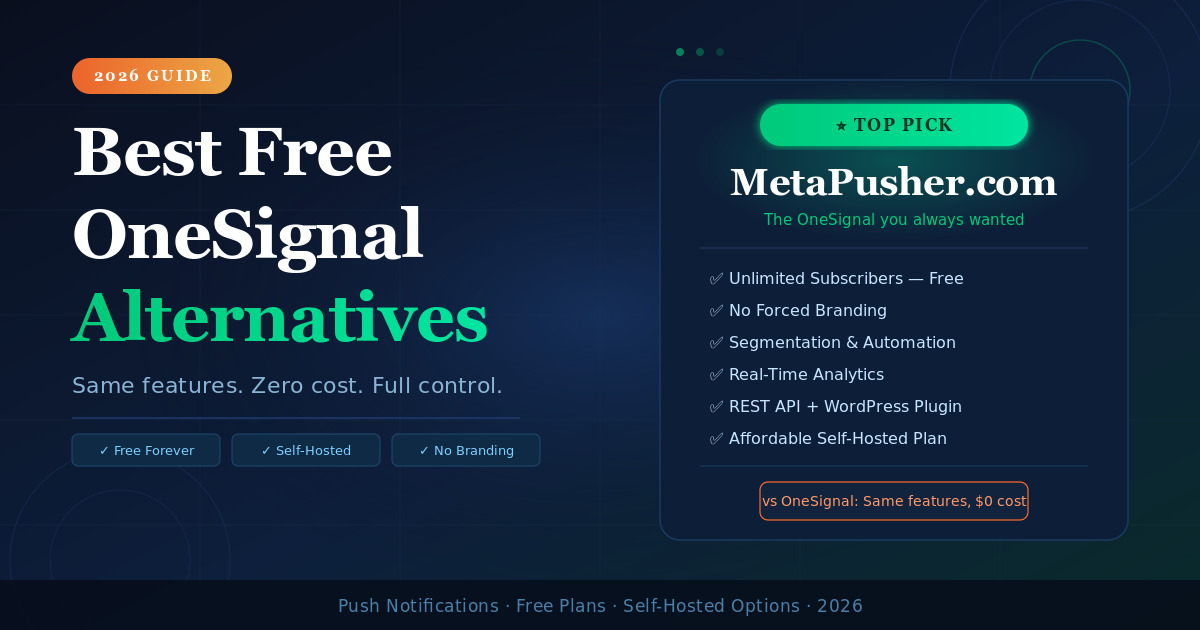
MetaPusher.com is a web push notification platform that lets you send push notifications to website visitors across all major browsers — Chrome, Firefox, Edge, and Safari. The feature set is genuinely on par with OneSignal, and the free plan does not feel crippled.
What You Get on the Free Plan
Here is what actually impressed me when I looked at the free tier:
- No subscriber cap — Unlike OneSignal, MetaPusher does not cut you off when you grow
- No forced branding — Your notifications look like they come from you, not from MetaPusher
- Audience segmentation — Target subscribers by location, device, behaviour, and more
- Scheduled notifications — Plan your campaigns in advance
- Automated drip sequences — Send a welcome notification, follow-up, and more automatically
- Real-time analytics — See delivery rates, click rates, and subscriber growth
- REST API access — For developers who want to integrate with their own apps
- WordPress plugin — Easy setup if you are on WordPress
- Works on HTTP and HTTPS sites — Not all platforms support this
That is not a stripped-down free plan. That is a proper product.
The Self-Hosted Plan — This Is Where It Gets Really Interesting
Here is the thing that separates MetaPusher from almost every other push notification service out there — they offer a self-hosted plan, and it is genuinely affordable.
What does self-hosting mean? It means you install MetaPusher on your own server. Your subscriber data never leaves your infrastructure. You are not dependent on MetaPusher’s servers staying up. You own everything.
For businesses dealing with GDPR, CCPA, or any kind of data compliance requirement, this is not just a nice-to-have — it is essential. And while most platforms that offer self-hosting charge a premium for it, MetaPusher keeps it accessible.
With the self-hosted plan you get:
- Complete data ownership — Subscriber data stays on your server, full stop
- White-label support — Use your own domain and branding everywhere
- All premium features included — No feature tiers, no upsells
- Custom scaling — Scale according to your own server capacity
- One-time or low monthly cost — Much more affordable than comparable self-hosted alternatives
Who Should Use MetaPusher?
Honestly? Almost anyone looking for push notifications. But specifically:
- Bloggers and content creators who want to grow a subscriber base without paying
- E-commerce sites sending cart abandonment and promotional campaigns
- News sites needing instant breaking news alerts
- Agencies building white-label notification tools for clients
- Privacy-focused businesses that need self-hosted infrastructure
My honest take: If you are switching from OneSignal and just want something that works without headaches or surprise bills, MetaPusher is where I would start. It is the closest thing I have found to “everything OneSignal offers, but actually free.”
2. Firebase Cloud Messaging (FCM) — Free But You Do the Heavy Lifting
Firebase Cloud Messaging is Google’s push notification infrastructure, and it is completely free. No limits on messages, no cost per subscriber — nothing.
The catch? It is basically a raw API. There is no subscriber management dashboard, no segmentation UI, no campaign builder. You get the delivery engine, and you have to build everything else yourself.
If you are a developer who enjoys that kind of thing — great. If you are a marketer or website owner who just wants to send a notification to your subscribers without writing code, FCM is going to frustrate you.
Good Parts
- Completely free with no message limits
- Backed by Google, so reliability is excellent
- Works across Android, iOS, and web
- Huge community and documentation
Not So Good Parts
- You need to build your own subscriber management system
- No out-of-the-box UI for non-developers
- Significant development time investment
- Still depends on Google’s servers — no self-hosting
Best for: Developers who want a free, reliable push delivery backbone and are comfortable building a custom frontend around it.
3. ntfy.sh — Charmingly Simple, Not Built for Marketing
ntfy (pronounced “notify”) is an open-source push notification tool that works over simple HTTP requests. You subscribe to a topic, someone sends a message to that topic, and you get a push notification on your phone or browser.
It is beautifully simple. I actually use it myself for server monitoring — when my server goes down, I get an instant notification on my phone. Takes five minutes to set up.
But — and this is important — ntfy is not built for website visitor push notifications. There is no way to show an opt-in prompt to website visitors, no subscriber list, no segmentation, no delivery analytics. It is a developer tool, not a marketing platform.
Good Parts
- Open source and self-hostable for free
- Incredibly simple HTTP-based API
- No account required to test
- Great for server alerts, CI/CD pipelines, home automation
Not So Good Parts
- Not designed for website visitor notifications
- No subscriber management or opt-in flow
- No analytics or campaign features
- Very limited use cases compared to OneSignal
Best for: Developers who need a lightweight tool for sending alerts to themselves or their team — not for audience engagement.
4. Pushover — Solid for Personal Projects
Pushover has been around for a long time and has a loyal user base. It is not free — but it uses a one-time payment model instead of a monthly subscription, which makes it very appealing if you hate recurring bills.
Pay once, use it forever. That is a refreshing business model in 2025.
That said, Pushover is really built for personal use or small teams. It is not a full-featured platform for managing thousands of website subscribers. Think of it more like a messaging app than a marketing tool.
Good Parts
- One-time payment, no monthly fees
- Reliable delivery with a clean app
- Simple API for developers
- Has been around for years — stable and trusted
Not So Good Parts
- Not free — only a 30-day trial
- Not designed for website visitor opt-in campaigns
- No segmentation or automation features
- Limited to personal or small team use cases
Best for: Individuals or developers who want a simple, one-time-pay notification tool for personal projects and server monitoring.
5. DIY Web Push with VAPID — Free But Costly in Time
This one is for the builders out there. Web Push notifications are an open standard, and with the VAPID (Voluntary Application Server Identification) protocol, you can send push notifications from your own server without any third-party service at all.
Libraries like web-push for Node.js make the implementation fairly straightforward if you know what you are doing. And once it is set up, it is completely free — you own the entire stack.
The problem? You are also responsible for everything. Subscriber storage, opt-in UI, retry logic on failed deliveries, segmentation, analytics — all of it is your problem to build and maintain. That is a significant time investment.
Good Parts
- Completely free — no third-party service involved
- Total data ownership from day one
- Full customisation — build exactly what you need
- No dependency on external platforms staying alive
Not So Good Parts
- High development effort — weeks, not hours
- You maintain reliability and uptime yourself
- No dashboard, no analytics, no UI out of the box
- Not practical for non-developers
Best for: Experienced developers who want maximum control, have the time to build it properly, and have strong reasons to avoid any third-party dependency.
Side-by-Side Comparison
Here is a quick overview to make your decision easier:
| Service | Free Plan | Self-Hosted | Dashboard UI | Segmentation | No Forced Branding | Best For |
|---|---|---|---|---|---|---|
| MetaPusher.com ⭐ | Yes — full features | Yes — affordable | Yes | Yes | Yes | Everyone |
| OneSignal | Limited | No | Yes | Paid only | Paid only | General use |
| Firebase FCM | Yes — API only | No | No | No | Yes | Developers |
| ntfy.sh | Yes | Yes | Minimal | No | Yes | Dev alerts |
| Pushover | Trial only | No | Basic | No | Yes | Personal use |
| DIY VAPID | Yes | Yes | Build it yourself | Build it yourself | Yes | Expert devs |
My Honest Verdict
After going through all of these, here is where I landed:
If you are a non-developer, a blogger, a small business owner, or someone who just wants push notifications to work without spending hours on setup or hundreds on subscriptions — MetaPusher.com is the obvious choice. It gives you everything OneSignal offers on a free plan, removes the frustrating limitations, and if you ever need to host it yourself for privacy reasons, that option is available at a price that actually makes sense.
If you are a developer who wants raw infrastructure and does not mind building everything else yourself — Firebase FCM is a solid, free backbone.
If you need server alerts and developer notifications rather than subscriber campaigns — ntfy.sh is charming and does that job well.
But for the majority of people reading this? Sign up for MetaPusher, spend 20 minutes setting it up, and stop worrying about your push notification platform. That is genuinely the advice I would give a friend.